
The Art I Couldn’t Stop Thinking About—So I Made It Myself
By: Ashlyn Walters / Southern Hospitality Company
It started, as most dangerously inspiring ideas do, with a casual stroll in Round Top, Texas. You know the kind where you leave your better judgment (and your minimalist design aesthetic) in the car and come back with wild ideas and probably a vintage decorative accessory you didn’t need.
I was somewhere between a linen tent and a lemonade stand when I saw it. A piece of art: painted botanical piece, tucked into a little booth that had colorful furnishings and patterned offerings. Greens, blues, soft whites all dancing loosely across a canvas layered over what looked like textured blue grass cloth. It was equal parts undone and sophisticated. Framed simply, but it didn’t need anything more. Of course, it wasn’t coming home with me. Not because I didn’t want it, but because there was exactly zero square inches left in my luggage. So I stood there for a moment longer than I probably should’ve, took in every detail, and moved on.
But the piece lingered in my mind throughout my travels back home.
A few days after we returned, I decided to recreate something inspired by what I saw, not a copy, but an echo. Something that carried the same mood: relaxed, coastal, slightly abstract, and totally intentional in its imperfection. Armed with a handful of paints from Hobby Lobby and mild delusion, I got to work.
The Supplies:
Before I even had a solid plan, I found myself at Hobby Lobby with a cart full of paints, brushes, and a vague sense of confidence. Here’s what I ended up using (and yes, these are all as specific as they sound because specificity is the difference between a Pinterest fail and a frame-worthy masterpiece):
- FolkArt Matte Paint in 2596 Sky Mist (background)
- Strathmore Acrylic Paper, 9×12
- Pencil
- FolkArt Paint in 515 Vintage White (base coat)
- WM639E French Blue (petals)
- DecoArt in 2554 Classic Green (stems and leaves)
- FolkArt 403 Navy Blue (flower centers)
- Oil Pastels in white, green, gray-blue
- Peel-and-stick blue grasscloth
- Light burlwood frames

Step 1: Paint the Background
Start by painting the entire sheet of acrylic paper in Sky Mist. It’s a cool, soft blue that looks like the kind of sky you only get after it rains in the South. Let it dry completely. Patience here is not just a virtue, it’s a design requirement.


Step 2: Sketch Loosely, Live Wildly
I scoured the internet for line drawing botanicals. A quick “Botanical Line Drawing” google search gave me plenty of inspiration. With a pencil, lightly outline your flower(s), stems, and leaves. Do this freely! No rulers, no perfection. Think of it as botanical jazz. Abstract, relaxed, a little whimsical. If you mess up, congratulations, you’re doing it right.


Step 3: White Base Layer
Paint over your pencil lines with Vintage White. This base will help the colors on top pop, like a primer but more charming. Let this dry fully before moving on. Yes, fully. Go fold laundry or ponder your life choices.


Step 4: Add the Petals in French Blue
Now we layer. Using French Blue, paint the inside of the flower petals, but leave a soft white border around each one. Don’t get too precious with the borders—some thicker, some thinner. The inconsistency is what gives it character. (We could all learn something from this technique.)


Step 5: Bring the Green
Repeat the process with your leaves and stems using Classic Green. Again, let the base white peek through. It adds dimension, texture, and that certain I-did-this-myself-but-it’s-still-elegant energy.


Step 6: Details That Don’t Obey the Rules
Once everything’s dry (and I do mean dry), go in with Navy Blue to add loose, expressive flower centers. Think spirals, blobs, and dashes. This is your moment of controlled chaos. Then go back in with more Vintage White to repeat the petal-bordering technique, this time over the navy. It softens everything and adds just enough layering to make people squint and ask where you bought it.


Step 7: Oil Pastel Magic
To finish the artwork itself, grab those oil pastels and outline the shapes loosely. Use green and white on the stems and leaves, gray-blue and white on the petals. You’re not coloring in the lines here, you’re giving it a frame of energy. Like a Southern drawl, it’s all in the edges. I then used a ruler to tear the borders of the paper to give a more weathered look.


Framing the Vision
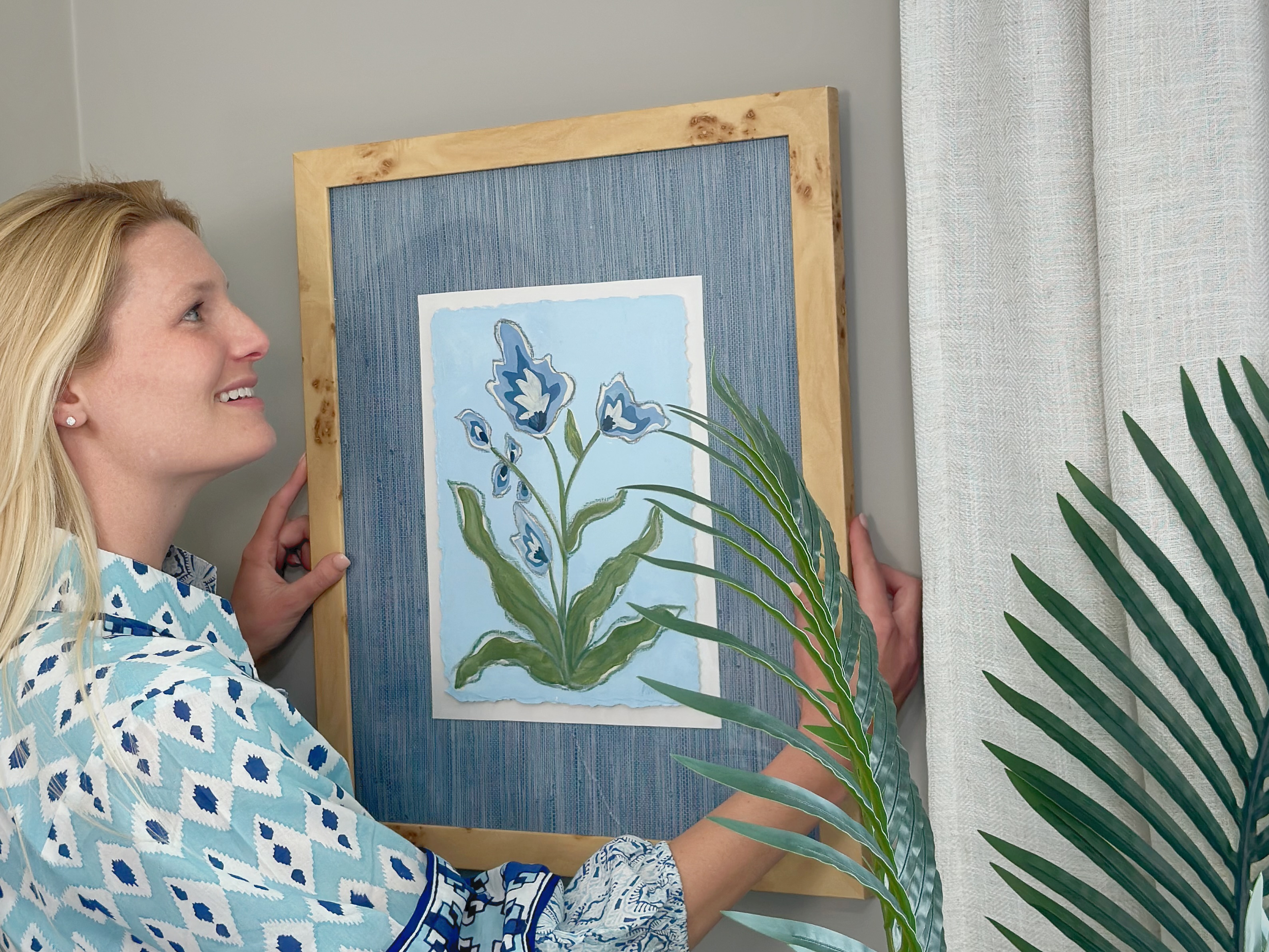
Here’s where it all comes together. I peel-and-stick blue grass cloth to mimic the texture I saw in Round Top. I cut it to fit the size of the matting inside a light burlwood frame, then mounted the artwork on top of a torn white acrylic paper sheet for a layered, linen-y effect.
The result? Relaxed, sophisticated, and totally unexpected. It fits perfectly in my blue-and-white coastal-inspired guest bedroom, like it was always meant to live there.
The Real Secret
Honestly? It was much easier than it looked. That’s the beauty of this kind of art: it doesn’t ask you to be a master painter. It just asks you to start, to layer, to step back, and then come back with fresh eyes. A little imperfection, a lot of instinct.
Try it. You might just walk past your own artwork one day and forget for a second that you made it.
And that’s when you know: you nailed it.


Products we used to make this art:


We’d love to hear your thoughts if you try this diy project! Enjoy!
Share this post:
Click this link to visit our shop! Follow us on social media below!
Southern Hospitality Company